Showing posts with label book: science fiction. Show all posts

Saturday, September 10, 2011

Review: Timecaster by Joe Kimball

Timecaster by Joe Kimball
Ace Books, June 2011
Genre: Science Fiction, Thriller, Ecopunk

From the Back of the Book:

Chicago, 2064: Talon Avalon is bored.

Talon is a timecaster—one of a select few peace officers who can operate a TEV—the Tachyon Emission Visualizer—which allows the user to record events (most specifically, crimes) that have already happened. Violent crime is at an all-time low and there hasn’t been an unsolved murder in seven years. So Talon has little to do except give lectures to school kids—and obsess about his beloved wife’s profession as a licensed sex partner.

Then one of her clients asks Talon to investigate a possible murder. And when Talon uses the TEV to view the crime, the identity of the killer is unmistakable—it’s him, Talon Avalon. Someone is taking timecasting to a whole new level and using it to frame Talon. And the only way he can prove his innocence is to go off the grid—which even in 2064 is a very dangerous thing to do…

My Thoughts:
I'm really surprised that I haven't heard any buzz about this book!  Timecaster is the first science fiction novel written by Joe Kimball, a pseudonym for JA Konrath who has previously written thriller and horror novels.  Timecaster is full of interesting world-building: a virtual Utopian society with no violent crime, legalized drugs, institutionalized prostitution and life after oil.  Technology is a big feature in Timecaster, both in creating the setting and driving the plot. The technology that changed the role of the police is warped by a mysterious figure to do terrible things in the name of the protagonist Talon.  Combined with the vivid world-building is fast-paced action that made Timecaster a breeze to read.

Part of the World-building is that society no longer runs of oil products.  Everything is run on biofuel which means, that between transportation needs and food needs, animals and plant products are in high demand.  It becomes illegal to own anything made from animal and plant products and citizens are required to contribute either credits or plant matter.  Every available surface is covered in plants- roads, walls, floors, and ceilings included!  The details created with this are absolutely lovely if terribly sad since paintings and books are now illegal.

While I really enjoyed Timecaster, there were some scenes that detracted from my enjoyment of the story.  There were certain sexual scenes that disturbed me.  I don't mind sex scenes in my science fiction but the portrayals of non-consensual sex with a male victim were handled very poorly.  I don't think their inclusion added to the story at all and the only compelling reason to not have the sex scenes be consensual is to show just how "old-fashioned" and faithful to his wife the protagonist is.  It also would have been more convincing if the non-consensual gang bang hadn't gone on until a male tried to join in.  Overall, not a flattering portrayal of anyone's sexuality.

The action and plot were enough to carry me through the book and come out with generally fuzzy feelings for the novel but the portrayals of sexuality did detract from my appreciation.  It might not have been as big a trigger if there hadn't been as large a tendency toward Sex Positive Culture.  I would probably still recommend this book because I did really enjoy it but it isn't going to make a favorites list.  I'm also going to look forward to the sequel coming out later this year.

Written as Part of the Speculative Fiction Challenge

Other September Reviews from the Speculative Fiction Challenge

Wednesday, July 13, 2011

Review: Deadline by Mira Grant

Deadline by Mira Grant
Orbit, May 2011
Genre: Science Fiction, Dystopian, Urban Fantasy, Young Adult

Official Description:


Shaun Mason is a man without a mission. Not even running the news organization he built with his sister has the same urgency as it used to. Playing with dead things just doesn't seem as fun when you've lost as much as he has.


But when a CDC researcher fakes her own death and appears on his doorstep with a ravenous pack of zombies in tow, Shaun has a newfound interest in life. Because she brings news-he may have put down the monster who attacked them, but the conspiracy is far from dead.

Now, Shaun hits the road to find what truth can be found at the end of a shotgun.

My Thoughts:

Spoiler Warning! Contains Major Spoiler for Feed!

I enjoyed Deadline a lot.  It wasn't quite the page turner that the first book, Feed, was but it was still a book that I put down as little as possible.  I found the plot of Deadline to be less focused and not as consistent pacing wise.  I think part of that results from the change in leadership and narrator from Georgia to Shaun.  Shaun isn't quite as focused and decisive as Georgia and the movement of the plot suffers a bit.  It does however allow for the interesting character twist in which Shaun presents as Schizophrenic with the voice of his dead sister in his head and during a few scenes as a full audio-visual hallucination.

I liked the introduction of a few more characters to the spotlight to give Deadline more of an ensemble cast feel than Feed.  I liked seeing more development of characters that had been previously introduced.

I loved the slow revelation of the larger picture of the Zombie epidemic.  I thought that the introduction of the CDC mystery was a clever touch.  The adventure of following the threads of the CDC mystery and the mystery of Georgia murder is fun and well executed and leads to the conclusion of the story with the biggest twist of all.

For me, Deadline wasn't quite as good as Feed but it has definitely set the stage for a dynamic and thrilling conclusion to the trilogy.  I definitely recommend reading Deadline and am super excited for the next book!

Written as Part of the Speculative Fiction Challenge


Other Reviews from this Series:
Feed by Mira Grant

Thursday, June 30, 2011

Review: Feed by Mira Grant


Feed by Mira Grant
Orbit, May 2010
Genre: Science Fiction, Dystopian, Urban Fantasy, Young Adult

Official Description:
"Alive or dead, the truth won't rest. My name is Georgia Mason, and I am begging you. Rise up while you can."
The year was 2014. We had cured cancer. We had beaten the common cold. But in doing so we had created something new, something terrible that no one could stop. The infection spread, virus blocks taking over buddies and minds with one, unstoppable command: FEED.
Now, twenty years after the Rising, Georgia and Shaun Mason are on the trail of the biggest story of their lives—the dark conspiracy behind the infected. The truth will out, even if it kills them.

My Thoughts:

I really enjoyed this book from start to finish. In a world where capturing the news has been outsourced to the blogosphere, the brother and sister partnership of Georgia and Shaun is both fun and sympathetic and the journey they invite the reader into is thrilling and engaging.

Each chapter is punctuated by a blog post, poem or quotation that both sets the stage for the coming chapter and gives further insight into the mindset of the character. I really enjoyed this set up and at times it was extremely moving- even to tears at one point.

I thought that the zombies were well utilized. They weren't the focus of the novel but they provided the framework for the society; the technology, social cues, cultural norms, political positions and catalysis for movement. I appreciated the scientific approach to the zombies and especially how that was revealed to the reader in a very gradual and natural manner. It was also neat to see how Grant had thought through how the political machines would be affected by the introduction of the zombie threat.

I really enjoyed Mira Grant's writing style and was really impressed by how the shift in perspective character before the final action sequence was handled. It was carried out very smoothly and didn't interrupt the flow of the narrative.

I highly recommend reading Feed and I definitely look forward to reading the sequel, Deadline.

Wednesday, June 22, 2011

Review: Dauntless by Jack Campbell

Dauntless by Jack Campbell
Ace Books, Reissue Edition June 2006
Genre: Science Fiction

Official Description:

The Alliance has been fighting the Syndics for a century, and losing badly. Now its fleet is crippled and stranded in enemy territory. Their only hope is a man who has emerged from a century-long hibernation to find he has been heroically idealized beyond belief.

Captain John "Black Jack" Geary's legendary exploits are known to every schoolchild. Revered for his heroic "last stand" in the early days of the war, he was presumed dead. But a century later, Geary miraculously returns from survival hibernation and reluctantly takes command of the Alliance fleet as it faces annihilation by the Syndics.

Appalled by the hero-worship around him, Geary is nevertheless a man who will do his duty. And he knows that bringing the stolen Syndic hypernet key safely home is the Alliance's one chance to win the war. But to do that, Geary will have to live up to the impossibly heroic "Black Jack" legend.


My Thoughts:
The premise of this science fiction tale is one that I found very intriguing and even better, it was skillfully executed. Campbell throws you straight in the action because the protagonist, John Geary, is thrown straight into the action. Since Geary wakes up from stasis in the middle of the war, Campbell is able to introduce the current situation to the reader by way of briefing Geary. Some of the chain of events that lead to Geary taking command of the fleet are a tad unbelievable but if you suspend belief the story takes us into a very believable retreat behind enemy lines.

Dauntless has a couple of the characteristics that tend to endear science fiction novels to me: the battles are described with as few technical terms as the author can get away with and don't dominate the novel, and the focus is on the social and political interactions within the crew and the fleet.

I found this to be an excellent and enjoyable read. It certainly did the job of enticing me to read the next book and I'd gladly recommend it to fellow science fiction fans.

Written as Part of the Speculative Fiction Challenge

Friday, May 20, 2011

Review: Live Free or Die by John Ringo

Live Free or Die by John Ringo
Baen Books, February 2010
Genre: Science Fiction
Unabridged Audiobook Narrated by Mark Boyett

Official Description:
First Contact Was Friendly

When aliens trundled a gate to other worlds into the Solar System, the world reacted with awe, hope and fear. When the first aliens to come through, the Glatun, turned out to be peaceful traders, the world breathed a sigh of relief.

Who Controls the Orbitals, Controls the World

When the Horvath came through, they announced their ownership of us by dropping rocks on three cities and gutting them. Since then, they've held Terra as their own personal fiefdom. With their control of the orbitals, there's no way to win and Earth's governments have accepted the status quo.

Live Free or Die

To free the world from the grip of the Horvath is going to take an unlikely hero. A hero unwilling to back down to alien or human governments, unwilling to live in slavery and with enough hubris, if not stature, to think he can win.

Fortunately, there's Tyler Vernon. And he has bigger plans than just getting rid of the Horvath.

My Thoughts:

Live Free or Die is an excellent example near-future science fiction. Ringo imagines both how aliens react to Earth and how Earth reacts to aliens with a believable flair. The main character, Tyler Vernon, is a hero written to appeal to a target audience: science fiction fans. Vernon is a web comic writer and general techie who due to changing circumstances ends up in a small town working odd jobs. He's easy for the target audience to relate to because he's one of them. Tyler Vernon is a geek well-placed and with the ingenuity and courage to step out of the crowd to discover a resource that Earth has to offer the aliens in orbit.

In a comical turn of events maple syrup turns out to be an intoxicant for one of the visiting species. I will never think of maple syrup the same way again! This turn of events allows Ringo to focus on the economic effects of an alien invasion on Earth and what lengths governments will go to try and have some control.

I also appreciated the more traditional science fiction aspects of the alien world and technology that help move along the plot and Earth's rebellion and technological revolution (led by Tyler Vernon).

The all-encompassing planning of Tyler Vernon doesn't ring as completely realistic but I was kept pretty well distracted from that by his dry sense of humor and good natured charm. I think that the reactions of the characters around him rang very true. I found Live Free or Die to be a fun and witty science fiction novel though it has the appropriate dark undertones for a captive Earth at the mercy of Aliens. I would certainly recommend this book and look forward to the sequel!

I listened to this as an audiobook which was definitely enjoyable. I thought the narrator did an excellent job of making the voices distinct. However, I was glad as a listener that there weren't too many female characters for him to voice since his attempts at feminine voices were pretty bad (I was less thrilled as a reader but it didn't detract from my enjoyment). This was a fun book to listen to and I think it transfered pretty well to the medium but someday I'll probably track down a paper copy and see how the experience differs.


Written as Part of the Speculative Fiction Challenge

Other May Reviews from the Speculative Fiction Challenge

Wednesday, March 16, 2011

Review: The Windup Girl by Paolo Bacigalupi

The Windup Girl by Paolo Bacigalupi
Night Shade Books 2009
Genre: Science Fiction

Official Description:
Anderson Lake is a company man, AgriGen's Calorie Man in Thailand. Undercover as a factory manager, Anderson combs Bangkok's street markets in search of foodstuffs thought to be extinct, hoping to reach the bounty of history's lost calories. There, he encounters Emiko...

Emiko is the Windup Girl, a strange and beautiful creature. One of the New People, Emiko is not human; she is an engineered being, creche-grown and programmed to satisfy the decadent whims of a Kyoto businessman, but now abandoned to the streets of Bangkok. Regarded as soulless beings by some, devils by others, New People are slaves, soldiers, and toys of the rich in a chilling near future in which calorie companies rule the world, the oil age has passed, and the side effects of bio-engineered plagues run rampant across the globe.

What happens when calories become currency? What happens when bio-terrorism becomes a tool for corporate profits, when said bio-terrorism's genetic drift forces mankind to the cusp of post-human evolution? Award-winning author Paolo Bacigalupi delivers on the most highly acclaimed science fiction novels of the twenty-first century.

My Thoughts:

I found the Windup Girl slow to start but once it got going I was fully engrossed in the story. Bacigalupi creates a stunningly detailed world where big agricultural business have grown completely out of control. I really loved the exploration of a potential road resulting from uncontrolled genetic modification of crops. Another science fiction issue that Bacigalupi tackled was that of human genetic engineering and the social response to the products of human-directed development. It was interesting to see the New People treated not just socially inferior but also legally so. It made the tension of discovering Emiko as a living being capable of independent thought much more poignant.

As much as I enjoyed the concepts central to the Windup Girl and the writing itself there were a few things that tainted my enjoyment of the novel. First, none of the characters were very likable. A partial sampling of the viewpoint characters: the corrupt, cold and calculating calorie man, the greedy and vicious factory administrator, the desperate windup girl, and a cruel and corrupt city guard.

Second, there is a scene that depicts fairly graphic sexual violence. The purpose of the scene is likely to demonstrate the societal opinion of the New People and to show why Emiko can't remain where she is but mostly it strikes me as completely unnecessary.

Overall, I enjoyed the Windup Girl. The world and the concepts that are explored were highly engaging and interesting. It has some issues and quirks as well as being a fairly dark and gritty novel. I would recommend the Windup Girl with the caveat that it isn't going to be a book for everyone.

Friday, March 4, 2011

Review: Mockingjay by Suzanne Collins


Mockingjay by Suzanne Collins
Scholastic Press, 2010
Genre: Young Adult Science Fiction

Official Description:
Against all odds, Katniss Everdeen has survived the Hunger Games twice. But now that she's made it out of the bloody arena alive, she's still not safe. The Capitol is angry. The Capitol wants revenge. Who do they think should pay for the unrest? Katniss. And what's worse, President Snow has made it clear that no one else is safe either. Not Katniss's family, not her friends, not the people of District 12. Powerful and haunting, this thrilling final installment of Suzanne Collins's groundbreaking The Hunger Games trilogy promises to be one of the most talked about books of the year.

My Thoughts:
I found Mockingjay to be a well thought out progression of events from the first two books, however this book just didn't work as well for me as the previous novels. Maybe it's because the scope is a bit wider than the previous books, or that Katniss doesn't make the transition from independence to the regimented life of District 12 very well, believable as the reaction is it makes her as the narrator a bit less likable.

Despite the parts that didn't work for me, I found the plot to be thoroughly engrossing. I liked the bits of the District 12 politics that were revealed and I thought that the ending was well thought out and provided a nice conclusion to the series.

I feel that Mockingjay was the weakest book in the series, but it is still definitely worth a read. I certainly didn't regret the time I spent with it.

Other Reviews from this Series:

Written as Part of the Speculative Fiction Challenge

Friday, January 21, 2011

Review: Catching Fire by Suzanne Collins

Catching Fire By Suzanne Collins
Scholastic Press, 2009
Genre: Young Adult Science Fiction

Official Description:
Against all odds, Katniss Everdeen has won the annual Hunger Games with fellow district tribute Peeta Mellark. But it was a victory won by defiance of the Capitol and their harsh rules. Katniss and Peeta should be happy. After all, they have just won for themselves and their families a life of safety and plenty. But there are rumors of rebellion among the subjects, and Katniss and Peeta, to their horror, are the faces of that rebellion. The Capitol is angry. The Capitol wants revenge. Suzanne Collins continues the amazing story of Katniss Everdeen in Catching Fire, the second novel of the phenomenal Hunger Games trilogy.

My Thoughts:
After reading The Hunger Games, I rushed out to buy Catching Fire. This book did not disappoint my excitement at all. I really enjoyed returning to see more of these characters. It was fascinating to see the consequences of decisions made by Katniss and Peeta in the first book and how the two dealt with those consequences. I think that the pressures on Katniss made the emotional tone of the novel even richer. I highly recommend reading Catching Fire and its predecessor The Hunger Games- you won't be disappointed!

Friday, January 7, 2011

Review: The Hunger Games by Suzanne Collins

The Hunger Games By Suzanne Collins
Scholastic Press, 2008
Genre: Young Adult Science Fiction

From the Back of the Book:
In the Ruins of a place once known as North American lies the nation of Panem, a shining Capitol surrounded by twelve outlying districts. The Capitol is harsh and cruel and keeps the districts in line by forcing them all to send one boy and one girl between the ages of twelve and eighteen to participate in the annual Hunger Games, a fight to the death on live TV.

Sixteen-year-old Katniss Everdeen regards it as a death sentence when she steps forward to take her sister's place in the Games. But Katniss has been close to dead before- and survival, for her, is second nature. Without meaning to, she becomes a contender. But if she is to win, she will have to start making choices that weigh survival against humanity and life against love.

My Thoughts:

I had heard so many wonderful things about The Hunger Games from various sources that I had been really excited about reading it. And The Hunger Games did not disappoint! Collins drops the reader right into a fantastic possible dystopian future setting. I felt that her portrayal of human nature and the extension of the modern tendency towards reality television into a deadly future game scenario was something that could plausibly happen. I thought that Katniss was portrayed as a very real person. and that she was very easy to connect to and care about. I didn't always like the way she thought or acted but it was still very real. The story continued to build momentum and the momentum carried me through the entire novel in one sitting. When I was finished, it was terribly disappointing that I didn't already own the next book.

I highly recommend reading The Hunger Games. It may be a young adult novel but it definitely contains some very difficult themes that make it fully worth reading as an adult.

Written as part of the Speculative Fiction Challenge.

Saturday, October 9, 2010

Review: Out of the Dark by David Weber

Out of the Dark is the first book of a new series by David Weber. Set in a near-future earth, Out of the Dark is a glimpse at an apocalypse brought on by alien invaders.

One of the qualities that helps to make Out of the Dark stand out is the use of the Alien invaders as viewpoint characters. I loved how the cultural differences between the aliens and humanity colors the interactions.

As much as I loved the Alien viewpoints, I had a hard time connecting with many of the human viewpoints. Until the end when all the viewpoint characters came together it was was to keep them straight and that made it difficult to care about what they were doing.

Despite the difficulty I had with some of the points of view, I had trouble putting Out of the Dark down. I loved how Weber treated the invasion and the destruction of civilization. It definitely made me think about how I would survive (or not) in the situation presented. Would the city I live in/near be one of the ones destroyed in the first waves of attacks on major population and technology centers or would it be one of the ones destroyed for resisting?

Despite the generally dark atmosphere of the novel, it ended with hope for the human race and the promise of more books to come as the human race speeds to rebuild and catch up to the rest of the populated universe.

I don't think this was one of Weber's better books but I did enjoy reading it and will definitely catch the next book in the series. I see a lot of potential for this new series.

Tuesday, May 11, 2010

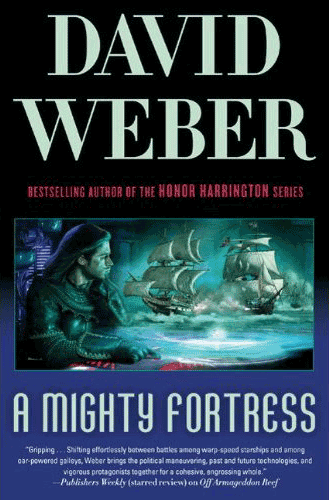
Review: A Mighty Fortress by David Weber

A Mighty Fortress is the fourth book in David Weber's Safehold series. The premise for the series in definitely intriguing: after a devastating space battle with an alien race, the last vestiges of human civilization form a colony and their leaders alter memories to create devotion to a religion that glorifies those leaders, demonizes their political enemies, and holds the colony at a low technological level. Nine hundred years later, an android body containing the mind of one of the original crew "wakes up" and starts a chain of events leading to innovation and change, and a religious reform movement that leads to a split in the church and the beginnings of Holy War.

This book is lighter on physical action than its predecessors but makes up for it with a high volume of political intrigue. Once again Weber has created a multitude of sub plots each with their own various political subtleties. At first some of the side plots seem unconnected to the main action but eventually everything falls into place.

One of the things that make David Weber's books so stunning is their epic battle scenes and even though he's switched from space battles to wet navy battles the battle scenes are still exquisitely detailed and realistic. The descriptions of the production process and the science behind the naval technology can get to be too much but the actual implementation of the technology makes it worth the heavy descriptions.

One of the things that is beginning to bother me about this series is the naming of the characters. The character names are often spelled in the most complicated rendition of the phonetic spelling possible. At first it was an interesting novelty but as time passed it just became distracting because every time a new character was introduced I had to pause to figure out what the standard equivalent of the name was. It definitely lead to interruptions in the flow of reading, especially since there are so very many characters involved.

Overall, I really did enjoy A Mighty Fortress. I love the political intrigue that features so strongly and the explorations of how religion molds the way people think and how the church acts as a political machine. I do feel that with the large number of character and political plots, some of the deeper character relationships get lost in the shuffle and that is unfortunate because it makes it harder to connect with the characters in this book. This book is a solid addition to the series (though not as good as the other three books) and leaves us set-up for a more action heavy fifth book.


Saturday, April 24, 2010

Reflection: The War of the Worlds by H.G. Wells

The War of the Worlds is a classic science fiction novel that is one scientist’s account of the Martian invasion of Earth that began in his home county and the events that followed. Even though, The War of the Worlds was written and set at the end of the 19th century it maintains a timeless nature. I think that part of what give The War of the Worlds its timeless nature is that Wells focuses less on the technological aspects of the story and more on the human emotional reactions to the crisis. The nature of humanity is one that never changes whether the humans in question are driving horses and carriages or cars.

Some of the philosophical issues presented by Wells are particularly fascinating. The Martians themselves are presented as a representation of a fully intellectualized species. The Martians have evolved into just large brains and hand-like tentacles and create machines to accomplish each purpose. At one point, using the Martians as a case study, Wells seems to warn against over reliance on machines.

I found this book to be thoroughly engrossing. It was an interesting look into the beginnings of the modern science fiction genre.


As an additional bit of interest, check out the 1938 radio broadcast of the War of the Worlds that aired the day before Halloween and caused mass panic.